

The three common centrifugal pump impeller types are open, semi-open, and closed. They differ in the plates, or shrouds, that surround their vanes. For you, that difference affects cleaning access, working clearances, and the liquid a particular pump can handle. It doesn’t guarantee efficiency or a solids rating.
If you’re comparing a pump quotation, look beyond the type name. Ask for its sectional drawing, permitted solids, and performance curve. Our centrifugal pump working principle and types guide explains the whole pump; here, we’ll focus on the impeller you’re specifying.
Compare the 3 Centrifugal Pump Impeller Types
A shroud is a plate attached to the impeller vanes. It rotates with them; it isn’t the stationary pump casing. In the common three-category system, open impellers have no front shroud and no full rear shroud, semi-open impellers have one shroud, and closed impellers have two. The Hydraulic Institute’s impeller definitions also allow minimal rear support in an open design.
| Impeller type | Construction | What you should check |
|---|---|---|
| Open | Exposed vanes; no front shroud and no full rear shroud | Permitted liquid and solids; vane-to-casing clearances; access for cleaning |
| Semi-open | One shroud, commonly behind the vanes | Exposed-side clearance; adjustment method; approved solids passage |
| Closed, or enclosed | Front and rear shrouds around the vane passages | Passage dimensions; internal running clearances; inspection and parts access |
Names vary between manufacturers. Some suppliers use “open” for an impeller without a front shroud even when it has a rear shroud. Ask for a sectional drawing showing both sides before you compare quotations.
You may also see radial, mixed-flow, vortex, or channel impellers. Those terms describe flow direction or a particular hydraulic design. They don’t replace the shroud comparison. A closed channel impeller and a closed clean-water impeller can have very different passages.
Open Impellers: Exposed Vanes and Cleaning Access
In an open impeller, you can see the working vanes without removing a front or rear cover from the impeller itself. The casing walls or liners help bound the liquid’s path. That access can make vane inspection and removal of lodged material easier after you’ve safely opened the pump.
Open designs are used in small pumps and in some pumps built for solids. But “open” doesn’t mean unrestricted. A piece of grit must still pass through the inlet, the space between vanes, and the discharge. A long fibre may behave differently from a round particle of the same thickness. You need the selected pump’s limits, not a label that says “dirty-water duty.”
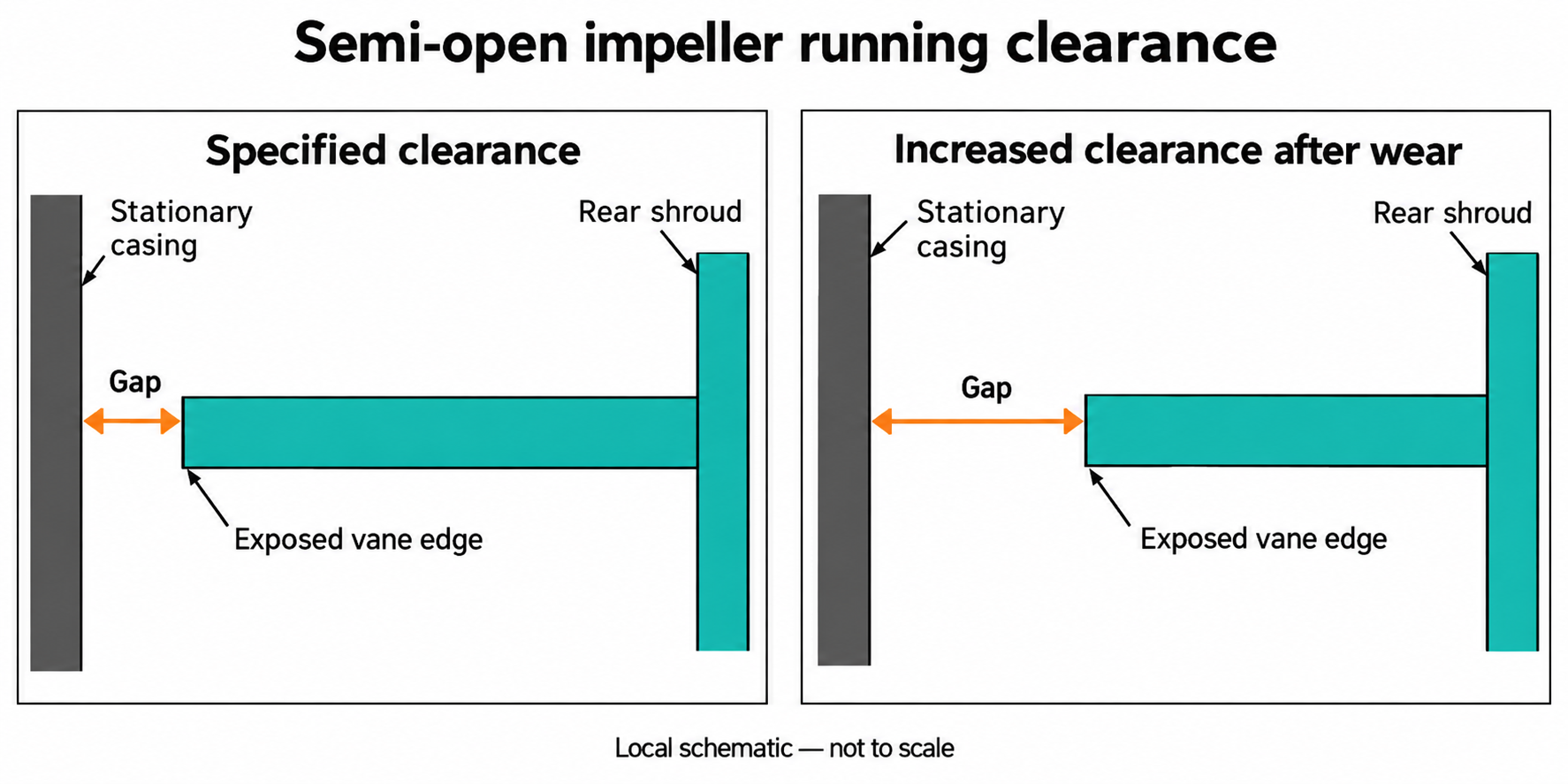
The exposed vane edges run near stationary surfaces. As those surfaces wear, the larger gaps can let more liquid circulate back instead of leaving through the discharge.
We recommend asking how those gaps are checked and whether the design allows adjustment or liner replacement. Also ask which parts the supplier expects you to keep in stock. Easy access is useful only if you can restore the working geometry when it wears.
Semi-Open Impellers: One Shroud and a Working Gap
A semi-open impeller has a shroud on one side, usually the rear, with the opposite vane edges exposed. The rear plate supports the vanes while leaving the front face accessible. This construction gives you a different combination of passage geometry, service access, and hydraulic performance from a fully enclosed impeller.
For a liquid with suspended particles, a suitable semi-open pump may be worth comparing. You’ll still need its particle-size and concentration limits. Two semi-open impellers can have different vane counts, passage widths, speeds, and materials. They shouldn’t receive the same service rating simply because each has one plate.
Pay attention to the gap between the exposed vane edges and the mating stationary surface. A gap that’s too large can increase internal leakage. A gap that’s too small can allow rubbing under the actual operating conditions. Don’t copy an adjustment number from another pump or assume the factory’s cold setting applies at every temperature.
Before you order, ask where the gap is measured, who can adjust it, and which manual covers your exact model. “Adjustable impeller” on a brochure isn’t a maintenance procedure.
Closed Impellers: Enclosed Passages and Internal Leakage
A closed impeller places its vanes between front and rear shrouds. Liquid enters through the eye and travels through the enclosed passages. You can often see the peripheral passage outlets, but the vane surfaces are less accessible than on an exposed design.
Closed impellers are common choices for clean-water duties, including circulation and pressure boosting. Their construction can help control leakage around the vane passages. However, you should compare efficiency at your operating flow and head. A pump’s size, hydraulic design, speed, condition, and distance from its best efficiency point also affect the result.
Closed doesn’t mean sealed against all internal leakage. Many designs use close running gaps at the impeller inlet, often with wear rings. When these parts wear, high-pressure liquid can return toward the suction side.
Nor does closed mean clean-water-only. Purpose-built closed single-vane and channel impellers can handle solids. For those pumps, check the specified free passage, the nature of the solids, and the approved operating conditions. Don’t transfer a wastewater impeller’s capabilities to a narrow-passage clean-water model.
How Should You Choose Centrifugal Pump Impeller Types?
Start with what’s actually in the liquid. For clean water, compare suitable closed-impeller pumps alongside any other approved designs. For suspended solids, supply the maximum particle size and concentration, and say whether the material is sand, soft fragments, or fibers. Include temperature, viscosity, and chemical composition.
Match the passage to the material, then compare performance. A rated round-particle passage doesn’t by itself prove that a pump can handle wet wipes or long fibers. If your liquid contains those materials, ask about a purpose-built channel, vortex, or cutter design. You won’t solve every clogging problem by changing from closed to semi-open.
Then give the supplier your required flow and total head together. Suppose your clean-water transfer duty is 12 m³/h at 28 m head. That’s an example duty, not a Draconis model rating. Request the curve for the offered impeller diameter and speed, with efficiency, absorbed power, and suction requirements at that point. Include low and peak demand so you can check the intended range. The Hydraulic Institute’s pump curve guide shows the information needed for that comparison.
Check suction conditions separately. Neither an open nor a closed label tells you how much net positive suction head the selected pump needs. Provide the lowest supply level, suction pressure, liquid temperature, and inlet losses. Have the supplier confirm the available suction head and required margin for the actual duty.
For an existing pump, include the model and serial number, current impeller part number, and measured operating flow and pressure. A replacement that fits the shaft may still have the wrong vane geometry, diameter, or running clearances. Ask for written confirmation of compatibility and the resulting curve. When reviewing our centrifugal pump range, send the same duty information so the discussion starts with your system.
Before you accept the quotation, confirm the wetted materials, wear parts, adjustment instructions, and how you’ll reach the impeller. Corrosion resistance and abrasion resistance are different checks; stainless steel isn’t an automatic answer to sand wear. Request spare-part numbers for liners or wear rings where fitted. Our water pump maintenance guide gives you a starting point for broader service planning.
Choose the Impeller Your Duty Can Support
When we compare centrifugal pump impeller types, the useful order is liquid, passage, curve, and service requirements. Open vanes give inspection access. A semi-open design adds one shroud and an exposed-side working gap. A closed design encloses the passages and still needs control of internal leakage.
Use those differences to ask better questions. Buy the pump whose documented liquid limits and curve meet your duty, with wear parts and maintenance instructions you can use. The type name helps you understand the construction; the supplier’s evidence lets you make the choice.
FAQs About Centrifugal Pump Impeller Types
Which impeller type should you choose for clean water?
A closed impeller is a common starting point, but clean water alone doesn’t decide the pump. Compare the actual flow and head, efficiency at your duty, suction requirements, and permitted operating range. A semi-open design can also be suitable when the manufacturer approves it for that service. Ask for the selected model’s curve rather than choosing from a generic efficiency ranking.
Can you replace a closed impeller with an open impeller?
Only if the manufacturer confirms the conversion for your pump. Check more than the shaft fit: the casing, mating wear surfaces, seals, clearances, and hydraulic performance all need review. Send the pump model and existing part number, then ask for approved replacement parts and the revised curve. Don’t treat a different impeller type as a direct cure for clogging.
Are open impellers always better for solids?
No. Some open designs handle solids well; others have small passages or unsuitable materials. Purpose-built closed channel impellers can also handle solids. You need the approved particle size, concentration, fibre tolerance, and wear limits for the whole pump. For abrasive or stringy material, tell the supplier exactly what it is before comparing open, semi-open, and closed options.