

An inline water pump has its inlet and outlet arranged along the same pipe centerline. That can make it easier to fit a pump into a planned pipe run, especially where floor space is limited. But the connection layout tells you little about the flow, pressure, liquid temperature, or controls you can expect.
We’ll explain five things to check before you choose one: the port geometry, how it moves water, where you can use it, its operating limits, and the installation details that affect service access. Start with the system you need to supply, then check the pump drawing and performance curve.
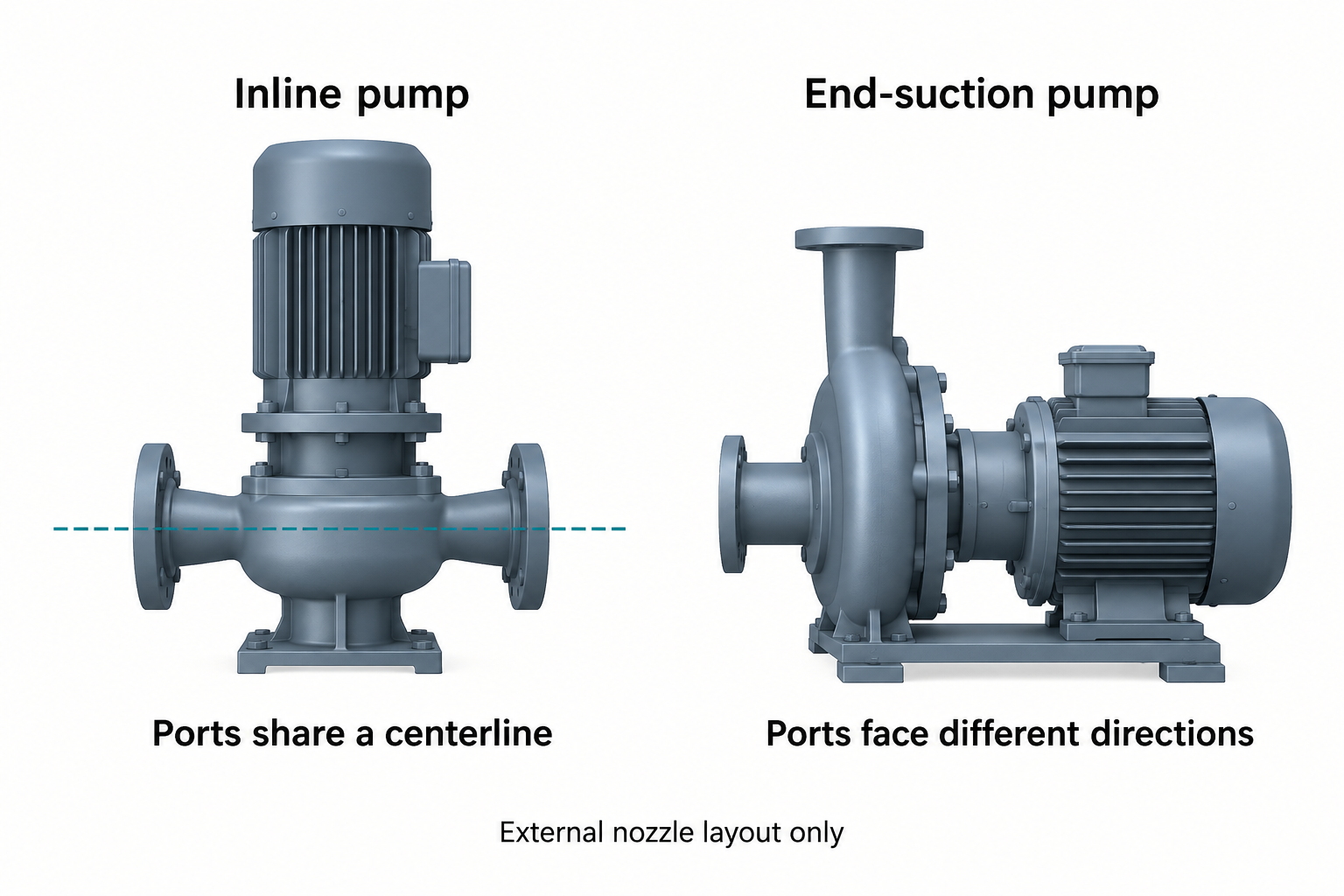
1. Inline Water Pump Ports Share a Pipe Centerline
On a conventional inline centrifugal pump, the suction and discharge connections face opposite directions on the same centerline. You can connect them to a pipe run without the offset used by many end-suction arrangements. This describes the ports, not a straight passage through the pump: water still changes direction inside the casing as it enters and leaves the impeller.
Motor orientation is a separate feature. A vertical inline pump can have a motor above the casing while its inlet and outlet connect to horizontal pipework. Some smaller circulators also have inline connections, but their motor construction, mounting rules, and service parts may differ significantly from a larger flanged pump. Don’t choose an installation method from the word “inline” alone.
Check the dimensional drawing for connection spacing, flange standard or thread type, motor position, and maintenance clearance. Two pumps with DN50 connections can still need different face-to-face lengths and supports. Ask whether the motor or rotating assembly can be removed while the casing remains connected. That depends on the design, and you’ll need room above or beside the pump to do it.
2. An Inline Water Pump Adds Head Through Its Impeller
Most inline water pumps used in building services are centrifugal designs. The motor turns an impeller, which transfers energy to the water. The casing guides the flow toward the discharge and converts part of the water’s velocity energy into pressure. Our centrifugal pump guide explains this mechanism and the parts involved.
The pump adds head, but it doesn’t deliver one fixed flow under every pipe condition. The Hydraulic Institute’s pump and system curve guide explains how the pump curve and system resistance determine the operating point. A partially closed valve or dirty filter can change the flow, even when motor speed stays the same. The inline layout itself does not provide automatic pressure control.
Read the curve at the flow you need. Maximum head usually refers to a condition near zero flow; maximum flow belongs to another point on the curve. Those two catalog values cannot be combined into a promised duty. For example, if your requirement is 12 m³/h at 18 m head, ask for confirmation at that pair of values, not a pump whose two separate maxima merely exceed them. This is an example specification, not a rating for a Draconis model.
3. Inline Water Pumps Fit Several Clean-Water Duties
You’ll find inline layouts in heating, cooling, industrial circulation, and some water-supply systems. The advantage is often the pipe arrangement and the space it leaves around equipment. An inline connection does not establish that the pump can handle every liquid used in those systems.
| Application | What the inline arrangement can help with | What you still need to check |
|---|---|---|
| Heating or chilled-water loop | Fits circulation equipment into a planned pipe route | Required flow, circuit resistance, water treatment, and temperature |
| Industrial heat-exchanger circuit | Places a circulation pump close to connected equipment | Equipment pressure loss, liquid compatibility, inlet conditions, and operating hours |
| Building water-supply boosting | Connects a pump into a distribution pipe where the duty permits | Available inlet supply, outlet demand, controls, and potable approvals where needed |
Heating circulation and drinking-water recirculation are different duties. A sealed heating loop may contain treated water or glycol, while a hot-water return serving taps needs components approved for potable use. Our hot-water circulation pump guide compares these applications. A cast-iron heating pump is not automatically a drinking-water pump.
For a site example, our TD pipeline circulation pump is described for clean, non-corrosive water, including hot-water circulation. Use its product page to begin a model discussion; request the selected configuration’s curve, dimensional drawing, and pressure-temperature limits. Its application list alone does not confirm potable approval, glycol compatibility, or suitability for your particular water supply.
4. Choose an Inline Water Pump by Duty and Limits
Write down your required flow and total head together. For a supply system, account for elevation, pipe losses, and the pressure required at the destination, while allowing for pressure already available at the inlet. For a filled, sealed circulation loop, the pump mainly overcomes friction and equipment losses; you don’t treat the entire building height as a continuous lifting duty. The loop’s fill pressure still matters for filling, venting, and equipment limits.
Send the supplier the liquid temperature, water chemistry, any glycol concentration, normal and maximum system pressure, and power supply. Check pressure limits at the operating temperature rather than combining separate maximum values. Also check inlet conditions: hot water, a restrictive strainer, or low source pressure can leave too little pressure at the impeller inlet. Ask the supplier to check the available suction conditions against the pump’s requirements.
The layout has limits. Inline ports don’t make a pump self-priming, resistant to dry running, quieter, or more efficient than another design at the same duty. Those results depend on the hydraulic design, motor, controls, installation, and operating point. If demand changes as valves close or taps open, check the control method, permitted flow range, and minimum-flow requirement. Pipe size and motor kilowatts alone cannot settle those questions. Compare the curve, service access, and mounting requirements before ordering a replacement, even when its connections appear to match.
5. Install Inline Water Pumps with Service Access in Mind
Follow the casing’s flow arrow and the model’s permitted mounting orientation. Provide the base, bracket, or other support the manufacturer specifies. Some smaller pumps are designed for pipe-supported installation; larger units may need their own support or foundation. In either case, don’t pull misaligned flanges together with bolts or leave the pump carrying unapproved pipe loads. Support the adjoining piping and account for thermal movement in hot-water circuits.
Plan safe access to isolation valves, vents, drains, electrical connections, and service parts. Check how much clearance you need to withdraw the motor, impeller assembly, or seal. A pump that fits between two pipe ends can still be difficult to repair beneath a low ceiling. Place insulation so it does not cover the motor ventilation, nameplate, or service points contrary to the manual. Fill and vent the pump before startup where required; an inline casing is not permission to run dry.
During commissioning, check rotation where applicable, actual flow, pump differential pressure, and electrical load against the agreed duty. Record valve settings and speed so later readings have a useful comparison. If flow falls or vibration changes, look for air, a blocked strainer, incorrect valve positions, and loose supports before assuming the pump needs replacing. Maintenance also depends on the design: a sealed small circulator and a separately coupled motor do not share the same lubrication or seal-replacement procedure. Isolate power and safely depressurize and cool the circuit before service.
Specify the Inline Pump You Can Install and Maintain
An inline water pump can simplify the connection layout, but you still need to match its hydraulic duty and liquid limits to the job. We recommend sending a supplier your flow and head, inlet conditions, liquid details, pipe connection requirements, and a sketch showing the available service space.
Before accepting a model, agree on its performance curve, mounting method, controls, and removal clearance. You’ll have a clearer basis for comparing quotations and checking the installation after startup. Matching the flange diameter is only one part of the decision.
Inline Water Pump FAQs
Is an inline water pump always vertical?
No. Inline describes the relationship between the suction and discharge connections, while vertical or horizontal describes a separate aspect of the pump’s arrangement. A common vertical inline design has the motor above the casing and opposing ports connected to horizontal pipework. Check the model’s dimensional drawing and permitted mounting positions; the supplier’s product name alone doesn’t tell you how to install it.
Can an inline pump solve low water pressure?
It can add head when its curve, inlet conditions, and controls match the supply duty. It cannot create a missing water supply or clear a blocked pipe. Before choosing a booster, check whether low pressure comes from inadequate inlet supply, pipe restrictions, elevation, or changing demand. For drinking water, also confirm the pump’s approvals and any local restrictions on direct connection to the mains.
Does an inline water pump need priming?
Most non-self-priming inline centrifugal pumps need their casing filled with water and air removed before operation. A flooded inlet or a filled heating circuit can supply that water, but trapped air may still need venting. Follow the selected model’s instructions for filling and startup. If the inlet pipe can empty, ask for a design and control arrangement suited to that condition rather than assuming inline means self-priming.