

A centrifugal pump moves liquid with a rotating impeller. If you’re buying one for a water system, the useful question is whether it can deliver your required flow at the pressure your pipework demands. A pump’s maximum flow and maximum head won’t answer that question on their own.
We’ll explain how centrifugal pumps work, how the common types differ, and where you can use them. You’ll also see what to check before you send a specification to a supplier.
What Is a Centrifugal Pump?
A centrifugal pump adds energy to a liquid so you can transfer it between tanks, circulate it through equipment, or deliver it under pressure. In a typical radial-flow design, liquid enters near the impeller’s center and travels outward through its vanes. The motor supplies power; the impeller transfers it to the liquid.
This is a continuous pumping process. Unlike a positive displacement pump, which traps and moves portions of liquid, a centrifugal pump’s flow depends on the resistance of the connected system. Close a discharge valve partway and you’ll usually reduce the flow. A change in tank level, filter condition, or pipe layout can also move the pump away from the duty you intended.
For distributors and project buyers, this explains why two pumps with the same motor rating may perform differently. Impeller geometry, speed, stage count, and hydraulic losses all affect their curves. KSB’s centrifugal pump reference describes the energy transfer behind this pump family.
Our centrifugal water pump range includes several configurations. Treat the product category as a starting point, then compare the curve for the model you’re considering.
How Does a Centrifugal Pump Work?
Inside the pump, the impeller turns with the shaft. Liquid enters the impeller eye, moves between the vanes, and leaves the impeller with more kinetic energy and pressure. The stationary volute or diffuser then slows and guides the flow, recovering part of its velocity energy as pressure. The discharge carries the liquid into your piping. The Petroleum Equipment Institute’s pump explanation describes this pressure recovery in the casing.
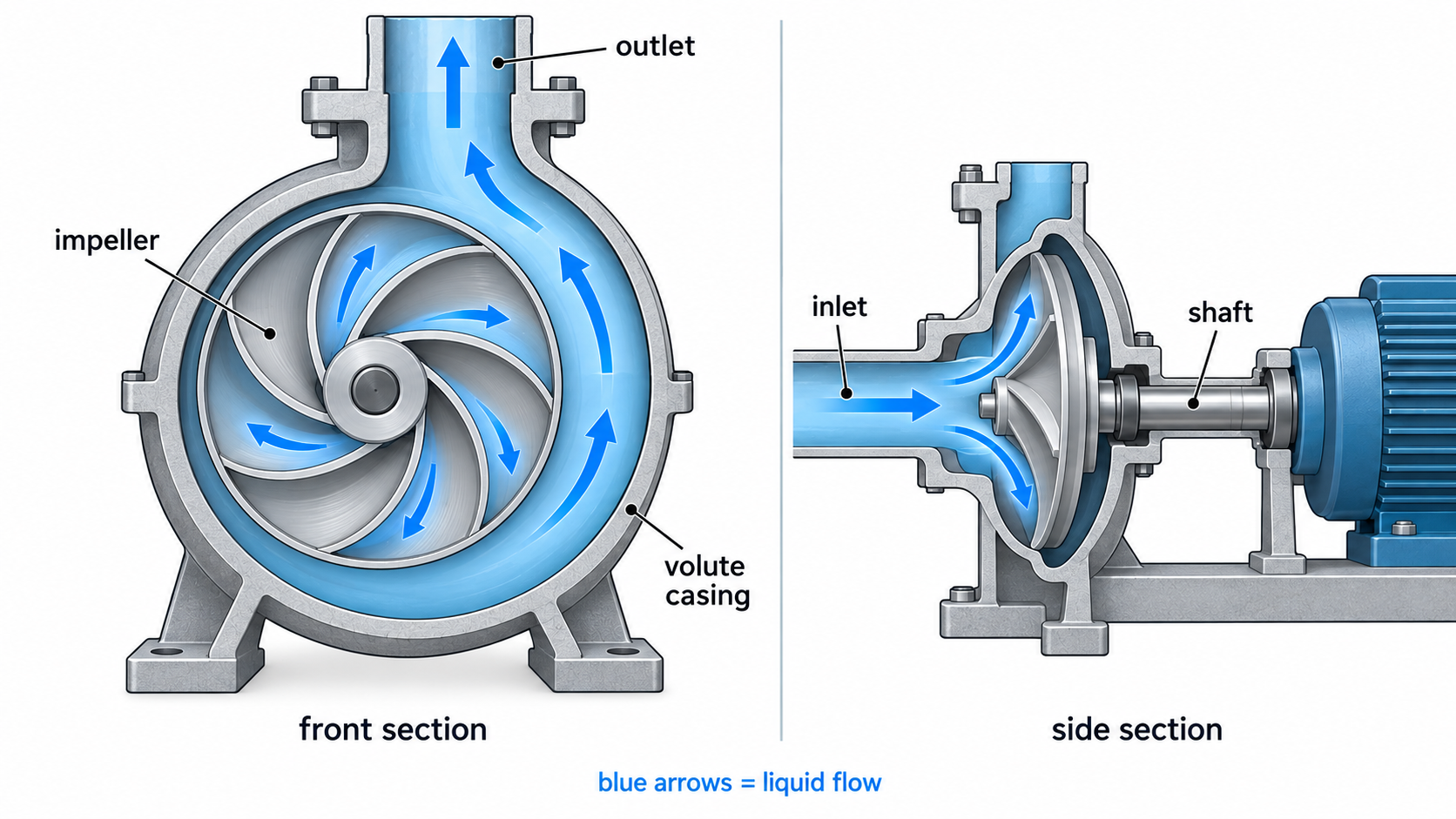
The casing contains the liquid, bearings support the rotating shaft, and a mechanical seal or packing controls leakage where the shaft passes through the casing. Some designs use other sealing arrangements, so don’t assume every centrifugal pump has the same service parts.
The pump doesn’t supply one fixed combination of flow and pressure. Its actual operating point is where its head-flow curve meets the system curve: the head your installation needs at each flow rate. The Hydraulic Institute’s pump and system curve guide explains this intersection.
For example, if a filter becomes blocked, resistance rises. At unchanged speed, your pump can deliver less flow even though the motor is still running. A larger motor alone won’t fix a blocked inlet, trapped air, or a poor pump-system match.
Head is expressed in meters or feet of the pumped liquid. It accounts for more than the vertical lift: your pump may also need to overcome pipe friction and provide pressure at the destination. Flow tells you how much liquid is delivered over time. You need both values to describe a duty.
Which Centrifugal Pump Types Should You Compare?
Pump names describe different features. A vertical pump can also be multistage, and a horizontal pump can also be single-stage. These aren’t separate boxes where you must choose only one label. End-suction and inline describe pipe connections; split-case describes how the casing separates for access. These labels can overlap on the same pump.
| Classification | Common centrifugal pump types | What it changes for you |
|---|---|---|
| Number of stages | Single-stage; multistage | One impeller versus several in series; compare the head required at your flow. |
| Shaft orientation | Horizontal; vertical | Floor space, pipe connections, and access for service. |
| Inlet and casing layout | End-suction; inline; split-case | How the pump fits the piping and how you reach its internal parts. |
| Impeller construction | Closed; semi-open; open | Liquid cleanliness, solids passage, and clearance maintenance. |
| Priming arrangement | Non-self-priming; self-priming | How you fill the pump and remove air before it can deliver liquid. |
A single-stage centrifugal pump has one impeller. It’s often a practical choice for tank transfer, circulation, or irrigation when its curve meets the duty. Don’t reject it simply because you need pressure: available head depends on the design and speed, not just the stage count.
A multistage centrifugal pump passes the liquid through successive impellers. Each stage adds head. At a given flow, more stages can provide more head; they don’t multiply the flow by the number of impellers. KSB’s multistage pump explanation describes this arrangement. Vertical multistage designs are useful when you need pressure and have limited floor space.
For dirty liquid, ask about the permitted particle size, solids concentration, and impeller passage. An open impeller alone doesn’t make a pump suitable for sewage, abrasive slurry, or stringy debris. Self-priming designs can clear air from a suction line under specified conditions, but you must still follow their initial filling instructions.
Where Are Centrifugal Pumps Used?
Water supply and pressure boosting. You can use centrifugal pumps to move water from a storage tank to a building or provide the pressure needed at outlets. Choose the duty based on simultaneous demand, elevation, pipe losses, and required outlet pressure. If demand changes during the day, assess a variable-speed system and its controls rather than expecting one fixed-speed pump to hold the same pressure at every flow. For building supply, our water pressure booster pump guide explains the controls and demand checks.
Cooling and HVAC circulation. A centrifugal pump can circulate water through heat exchangers, cooling equipment, or heating circuits. In a filled, closed loop, the pump mainly overcomes friction and equipment pressure losses; it doesn’t continuously lift the water through the full building height. An open cooling-tower circuit needs a different head calculation. Check fluid temperature, glycol content if used, seal materials, and the permitted operating range.
Water treatment and irrigation. Filtration skids and irrigation networks need enough head to overcome their equipment and distribution losses. For an example of the pump configuration, our CDLF vertical multistage centrifugal pump lists clean water as its approved fluid and SS304 for its casing, impeller, and shaft. Confirm the selected model’s curve and liquid limits before specifying it for a treatment stage or farm supply.
Centrifugal pumps designed for those liquids can also handle industrial wastewater, chemicals, and slurry. A clean-water model isn’t a substitute. Give the supplier the liquid composition, temperature, solids data, and seal requirements rather than relying on an application label.
How Do You Select a Centrifugal Pump for Your System?
Start with a duty point: required flow and total head at that flow. Suppose you’re transferring water from an open source tank to a pressurized receiving tank at 10 m³/h. The receiving tank is 12 m higher, pipe and fitting losses are 8 m at that flow, and the receiving tank needs 15 m of gauge pressure head. With negligible surface velocities and no gauge pressure at the source, the duty is 10 m³/h at 35 m head. This is a worked example, not a rating for a Draconis model.
Use the curve for the correct speed and impeller diameter to check that duty. Maximum head commonly occurs near zero flow, while maximum flow is at much lower head. You can’t combine both catalog maxima into one operating point. Also check shaft power across the intended flow range and select the motor with the supplier; kilowatts alone don’t tell you whether the hydraulic duty is covered.
Look for operation near the best efficiency point (BEP) and within the manufacturer’s preferred operating region. BEP is where pump efficiency peaks for a given speed and impeller diameter. The Hydraulic Institute’s pump curve guidance explains how efficiency, power, and suction requirements change with flow. Include your low, normal, and peak demand so the supplier can check the range, not just one point. Ask for minimum continuous flow too.
Check suction conditions separately. Low tank level, hot water, long suction pipework, or a dirty strainer can leave too little pressure at the impeller inlet. Net positive suction head available (NPSHA) must meet the pump’s requirement with an appropriate margin. The Hydraulic Institute’s NPSH margin guidance makes clear that the margin depends on the liquid, pump, and site conditions. Don’t assume that matching a published NPSH3 value means cavitation-free service; NPSH3 is based on a 3% head drop during testing.
Before ordering, document the liquid and temperature, inlet conditions, supply voltage and frequency, available space, and control method. Confirm wetted materials, seals, drinking-water approvals where relevant, and access to spare parts. Our 304 vs 316 stainless steel water pump guide is a starting reference for material discussions. Final material selection still needs your water chemistry and the supplier’s compatibility check.
After installation, compare measured flow and pump differential pressure with the agreed performance data. Record inlet pressure, tank level, speed, and valve positions at the same time. Those details help you distinguish a pump problem from a change in the connected system.
Choosing a Centrifugal Pump You Can Specify Clearly
A centrifugal pump uses a rotating impeller to add energy to liquid, while the casing guides the flow and recovers pressure. Stage count, orientation, casing layout, and impeller construction help you describe the configuration you need. The operating curve tells you whether it can meet the job.
When you request a quotation, send your flow and head together, then add the liquid, suction conditions, power supply, and demand range. We recommend agreeing on a model-specific curve and operating limits before placing an order. You’ll have a clearer basis for comparing pumps and checking the installation after startup.
Centrifugal Pump FAQs
Does a centrifugal pump need priming?
Most non-self-priming centrifugal pumps need the casing and suction line filled with liquid and the air vented before startup. A flooded suction arrangement can supply this liquid, but you still need to remove trapped air. Self-priming models also require initial filling. Follow the model’s manual; KSB’s priming guidance explains the difference between these arrangements.
Can a centrifugal pump handle thick oil or solids?
Some designs can, but a clean-water curve won’t establish their performance on thick oil. Higher viscosity changes flow, head, efficiency, and power demand, as KSB’s viscosity reference explains. For solids, specify particle size, concentration, and abrasiveness. You may need a dedicated solids-handling centrifugal pump or a positive displacement pump, depending on the duty.
Why can a centrifugal pump lose flow or make a rattling noise?
Check for an empty source tank, air entering the suction line, a blocked strainer, incorrect rotation, and worn hydraulic parts. Cavitation is another possible cause: vapor bubbles form where local pressure is too low and collapse as pressure rises. KSB’s cavitation reference describes the resulting noise, rough running, and possible erosion. Stop and investigate abnormal operation instead of running the pump through it.