

Hot water circulation pumps move heated water around a pipe circuit. You can use them to bring hot water closer to taps, carry heat to radiators, or move heat between equipment. The pump provides circulation; the water heater, boiler, heat pump, or solar collector supplies the heat.
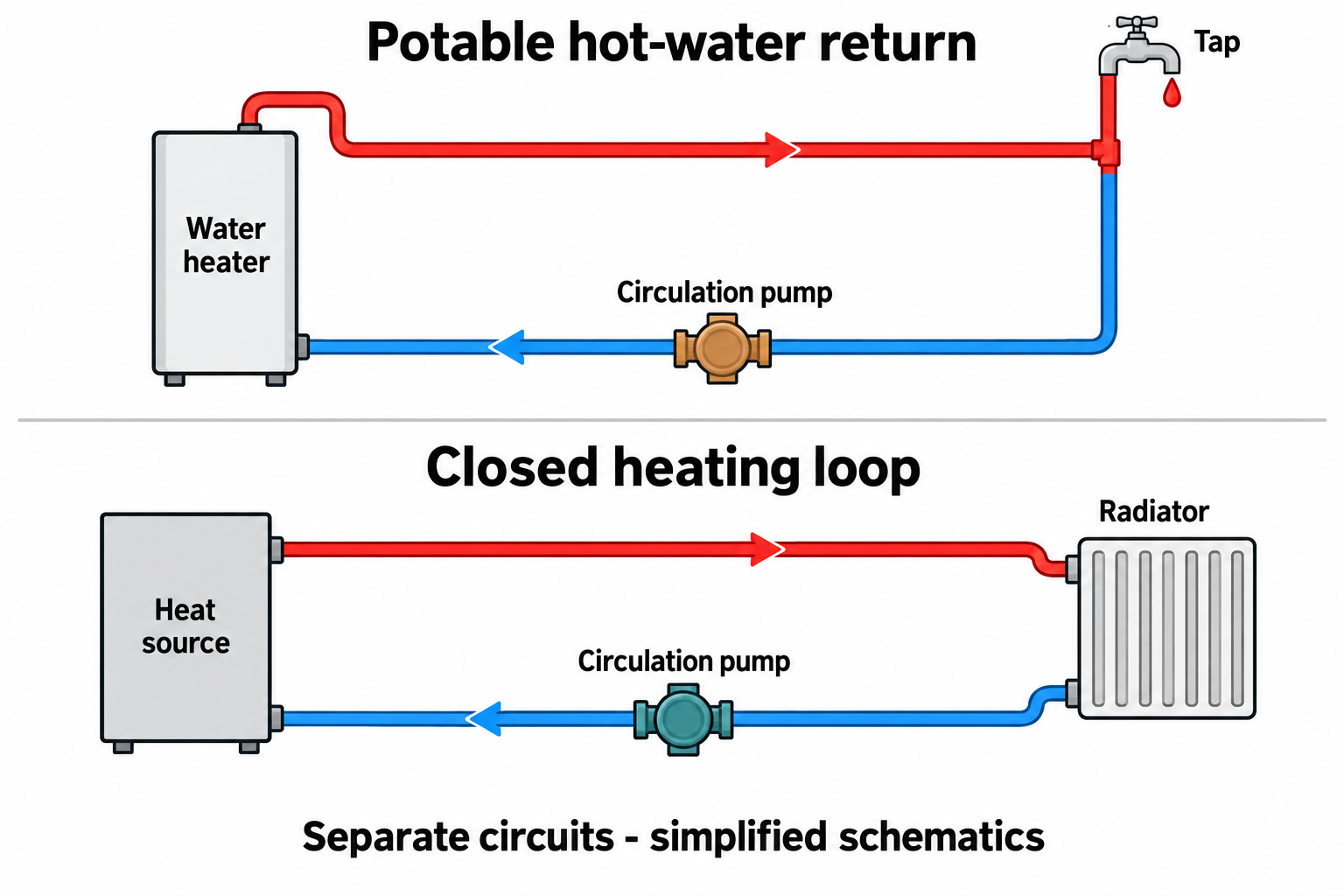
Before choosing a pump, identify what is inside the loop. Domestic hot water reaches your taps and needs components approved for drinking-water service. A sealed heating circuit carries water, sometimes with treatment chemicals or glycol, through emitters and back to the heat source. These systems need different materials, controls, and installation checks.
We’ll compare five common uses, including where each helps and what you need to allow for. The same label on a pump does not make it suitable for every hot-water circuit.
| Hot-water use | Main benefit | Main limitation |
|---|---|---|
| Residential hot-water return | Less waiting and less water discharged while you wait | Pipe heat loss, pump electricity, and return-path installation |
| Central commercial hot-water return | Serves outlets along a larger distribution network | Branch balancing and building water-management requirements |
| Radiator heating loop | Carries heat from the heat source to radiators | Air, valve changes, and poor flow balance can affect rooms |
| Underfloor heating loop | Distributes heated water through floor circuits | Manifold balancing and supply-temperature control need checking |
| Active solar water-heating circuit | Transfers collected heat to a storage tank | Collector temperature extremes and fluid compatibility require checks |
1. Hot Water Circulation Pumps for Residential Taps
If your bathroom is far from the water heater, water in the connecting pipe can cool between uses. You then open the tap and wait while that cooled water leaves the pipe. A domestic hot-water recirculation system returns water toward the heater instead of sending all of it down the drain.
Pros. You can shorten the wait at outlets served by the loop and reduce the water you discharge before it reaches the temperature you want. A dedicated hot-water return pipe provides a defined circulation route. In suitable retrofit systems, a controlled crossover valve can use the cold-water pipe as a temporary return path, avoiding a separate return pipe.
Cons. You still pay for pump electricity, and keeping distribution pipes warm increases heat loss. A crossover arrangement can temporarily warm the cold-water line. A dedicated return may require access through finished walls. Neither layout guarantees immediate hot water at every tap: short branches beyond the loop can still cool. Choose the control with your usage pattern in mind. The U.S. Department of Energy’s hot-water recirculation on demand guide describes circulation triggered when hot water is requested. Demand control can limit unnecessary running; it does not mean there is no wait after activation. Insulate the loop and check the heater’s requirements, return connection, and check-valve arrangement before installation.
2. Hot Water Circulation Pumps for Hotels and Shared Buildings
Hotels, apartment buildings, and other shared facilities can have long hot-water supply pipes with several branches. A central return network brings water from those branches back toward the hot-water plant. This is a potable distribution system, separate from a sealed space-heating circuit.
Pros. You can keep hot water closer to occupied rooms without placing a separate heater at every outlet. Return piping also gives the operator defined locations to measure loop temperatures and check circulation. Where the system has several branches, balancing valves help distribute the intended return flow rather than letting the easiest path take most of it.
Cons. A running pump does not prove that every branch has sufficient circulation. Poor balancing, closed valves, long dead-end branches, and damaged insulation can leave some outlets waiting while others receive more flow than needed. Continuous circulation can add distribution heat loss, so controls must reflect how the building actually operates. Confirm potable-water approvals for the pump and other wetted components. Coordinate controls with the building’s water-management and scald-protection requirements; do not apply a household timer schedule to a hotel without checking those requirements. The pump moves water but does not disinfect it or replace the building’s water-safety measures.
3. Hot Water Circulation Pumps for Radiator Heating
In a sealed radiator circuit, the circulation pump carries heated water from a boiler or heat pump through radiators and returns it to the heat source. If you need the basic impeller explanation, our centrifugal pump guide covers how this pump family moves liquid.
Pros. Forced circulation lets you distribute heat through pipework to several rooms. You can combine the pump with zone valves, radiator valves, and appropriate controls to serve different heating demands. Some installations benefit from a variable-speed circulator that responds to changing differential pressure as valves open and close.
Cons. Too little flow can leave emitters short of heat; unnecessary flow can cause valve noise and use more electricity. Trapped air, accumulated debris, or a closed valve may prevent circulation even when the motor runs. A pump change will not correct a blocked circuit or an incorrectly balanced radiator network. Select the pump against the circuit resistance at the required flow. In a fully filled, sealed loop, you do not add the full building height as a continuous lift duty: the rising and descending water columns balance. The system’s fill pressure is a separate check. Cast-iron pump bodies may be allowed in suitable closed, treated heating circuits, but do not carry that choice over to oxygen-rich potable hot water.
4. Hot Water Circulation Pumps for Underfloor Heating
Underfloor heating sends warm water through pipe circuits connected to a manifold. Depending on the design, a circulation pump serves a mixing assembly, a heating zone, or the wider heat-source circuit. Not every manifold needs its own pump, so check the complete piping arrangement before adding one.
Pros. You can supply several floor loops from a manifold and adjust their flows to match the design. Flow meters and balancing settings help you account for differences in loop length. Zone actuators and coordinated pump controls allow rooms to call for heat separately.
Cons. Long floor circuits add resistance, and a poorly balanced manifold can send more water through short loops while starving longer ones. Raising pump speed does not replace balancing. When several actuators close, the controls must manage reduced flow without leaving the heat source outside its permitted operating conditions. The pump also cannot set a safe floor temperature by itself. Your heat-source control, mixing arrangement where needed, and floor-system design determine the supply temperature. Use the specified flow and pressure-loss data for the loops, manifold, and valves. Confirm the heat source’s minimum-flow requirements and how the pump stops or changes output as zones close.
5. Hot Water Circulation Pumps for Active Solar Water Heating
An active solar water-heating system uses a pump to move fluid through a collector circuit. In an indirect arrangement, a heat exchanger transfers that heat to stored water while keeping the collector fluid separate from drinking water. Passive solar water heaters can circulate without a pump, so this use applies to active systems.
Pros. Pumped circulation lets the controller move heat when the collector is hotter than the storage tank. You can position components according to the approved system design rather than relying entirely on natural circulation. Indirect systems can use an appropriate heat-transfer fluid where freeze protection is required.
Cons. The pump needs power, controls, and a working temperature sensor arrangement. Solar collectors may reach temperatures well above the normal operating condition when circulation stops. Glycol concentration, fluid condition, seals, and the pump’s temperature limits all need checking. A standard domestic recirculation pump is not automatically suitable for this duty. Follow the collector-system supplier’s specified pump, fluid, and overheating or freeze-protection arrangements. Solar water heating uses collected heat; a photovoltaic panel powering an ordinary water pump is a different application. DOE’s guide to active solar water heating explains the distinction between active and passive systems and direct and indirect circulation.
Match Hot Water Circulation Pumps to the Whole Loop
Tell the supplier whether the circuit carries drinking water, treated heating water, or another heat-transfer fluid. Then provide the required flow, pipe and equipment pressure losses, normal and maximum fluid temperatures, system pressure, control method, and power supply. Confirm the permitted pressure at the operating temperature; two separate maximum ratings do not establish that both can be used together.
For potable service, ask for the applicable drinking-water approvals for the complete pump, not just a stainless-steel material description. For heating or solar circuits, check the approved water treatment or glycol concentration. Include service space, isolation valves, venting, and the manufacturer’s installation orientation. Hot liquids also make inlet conditions important: confirm the available inlet pressure meets the selected model’s requirements. You can browse our circulation pump category to start a specification discussion, then request confirmation for your exact liquid, temperature, pressure, and duty. The category label alone does not confirm potable or solar compatibility. Our water pump maintenance guide covers inspection topics; use the selected circulator’s manual for its service procedure.
The useful choice is a pump and control arrangement that fit your loop. For taps, focus on the return path and potable requirements. For heating, check circuit resistance and changing zone demand. For solar, account for the collector fluid and temperature extremes before ordering.
Hot Water Circulation Pumps FAQs
Do hot water circulation pumps heat the water?
No. The pump moves water or a heat-transfer fluid through the circuit. A water heater, boiler, heat pump, or solar collector supplies the heat. If water remains cool while circulation is operating, check the heat source, control signal, return arrangement, valves, and actual flow. A running motor alone does not show that heated water is reaching the intended outlet or heating circuit.
Can one circulation pump serve drinking water and heating?
Do not assume it can. Drinking-water systems need pumps and wetted components approved for potable service. A sealed heating loop may contain treatment chemicals or glycol and may allow different materials. Check the model’s stated application, approvals, seals, fluid compatibility, and installation limits. Keep the two circuits separate; selecting a similar-looking pump does not make their water or plumbing interchangeable.
Should a hot water circulation pump run all the time?
That depends on the system. A household demand-controlled return can run when requested, while heating pumps usually follow the heat-source and zone controls. A shared building’s potable return needs controls consistent with its water-management requirements. Running continuously can increase electricity use and pipe heat loss. Agree on the control sequence for the actual application instead of applying one schedule to every hot-water loop.