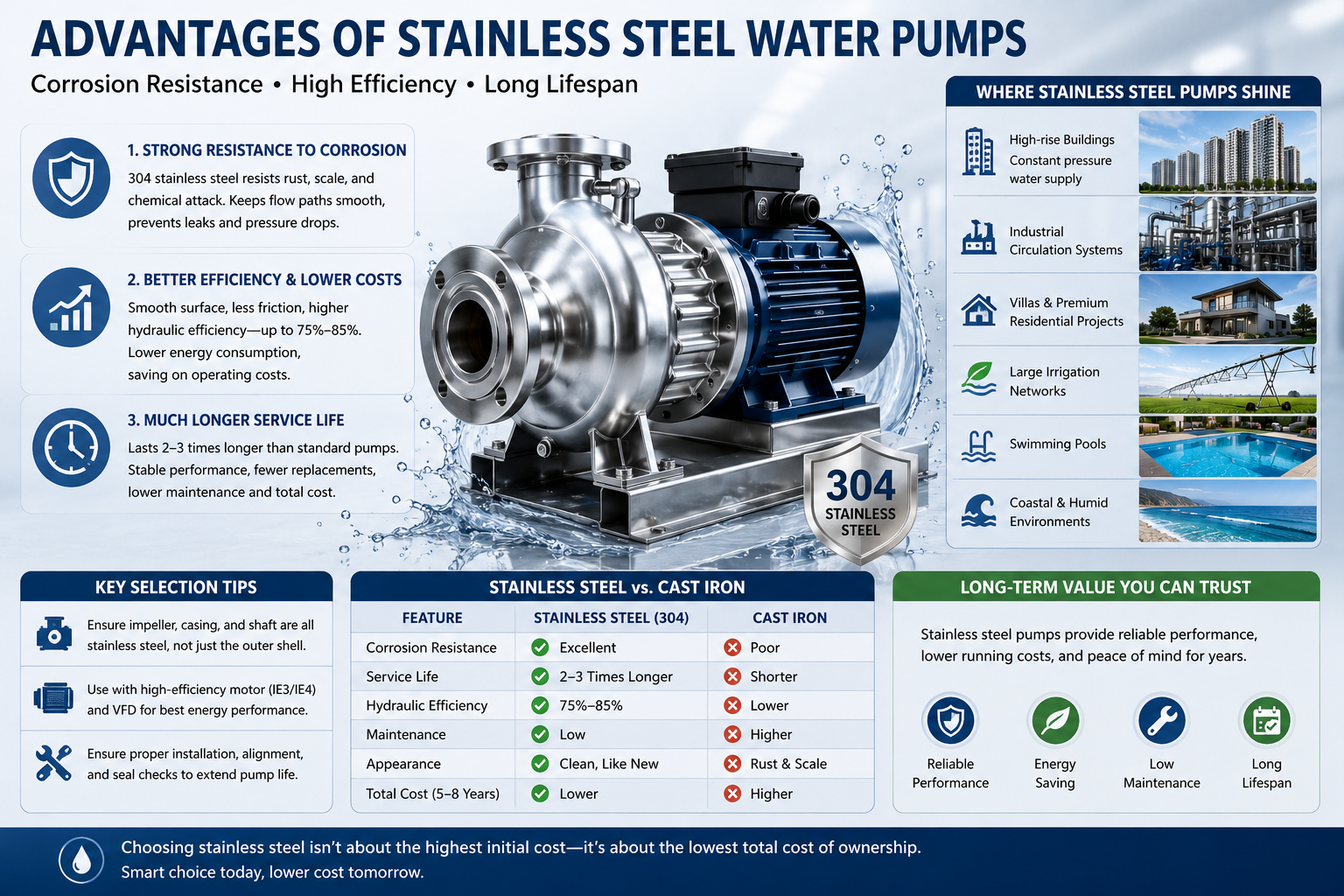

When it comes to choosing a water pump that will actually last and perform well, material is one of the most important decisions you’ll make. Over the years, stainless steel pumps (especially 304 ) have proven themselves as a smart choice for both industrial users and higher-end residential projects. Here’s why they stand out in real applications.
Why Stainless Steel Makes a Big Difference
Water isn’t as harmless as it looks. Even in relatively clean conditions, it carries dissolved oxygen, small amounts of chlorides, and slight acidity or alkalinity that slowly eat away at ordinary cast iron or carbon steel parts. Stainless steel fights back naturally. Its chromium-rich surface forms a protective layer that repairs itself, giving the pump a much better chance at staying strong over time.
Real-World Advantages
Strong Resistance to Corrosion 304 stainless steel handles normal water conditions very well. Pumps made with these materials rarely develop rust or scale inside. This keeps the flow paths smooth, maintains efficiency, and prevents those annoying leaks or pressure drops that appear after a couple of years with other materials.
Better Efficiency and Lower Running Costs Because stainless steel can be precisely cast and polished, the impeller and pump chamber have much smoother surfaces. Less friction inside means higher hydraulic efficiency — often reaching 75% to 85% in good models. For factories or buildings running pumps day after day, this difference shows up clearly on the electricity bill.
Much Longer Service Life In practice, a well-made stainless steel pump often lasts two to three times longer than standard pumps under the same workload. The performance doesn’t drop off quickly, so you get stable flow and pressure for much longer. This means fewer replacements, less maintenance work, and significantly lower total costs in the long run.
Other practical benefits include better pressure handling during system fluctuations, wider temperature tolerance, and easier cleaning because the exterior stays looking new with minimal effort.
Where Stainless Steel Pumps Shine
You’ll see the biggest return in high-rise buildings that need reliable constant pressure, industrial circulation lines, premium villas, large irrigation networks, swimming pools, and any project near the sea or in humid climates.
Selection Tips from Experience
Make sure the key wet parts — impeller, casing, and shaft — are all stainless, not just the outer shell.
Combine it with a high-efficiency motor (IE3 or IE4) and a variable frequency drive whenever possible. This combination delivers the best energy performance.
Don’t skip proper alignment and seal checks during installation — these small details add even more years to the pump’s life.
Things People Often Get Wrong
Many assume stainless steel is “too expensive.” But if you calculate electricity costs and maintenance over 5–8 years, it usually turns out to be the cheaper option. Another common mistake is thinking all stainless steel pumps are equal — the difference in casting quality, wall thickness, and seal standards between brands can be surprisingly large.
Choosing stainless steel isn’t about buying the flashiest option — it’s about making a practical decision that saves trouble and money over time. For projects where reliability and operating costs matter, it’s often the most sensible choice.
If you’re evaluating pumps for a specific project right now, feel free to share your main parameters (flow, head, environment, running hours, etc.). We regularly help clients select the right stainless steel pump configuration for their actual needs.
What matters most to you when choosing pump materials?