

When choosing a water pump, many buyers assume “a pump is just a pump.” In reality, industrial clean water pumps and domestic water pumps differ significantly in design, construction, and performance requirements. Choosing the wrong type can lead to premature failure, excessive energy consumption, or insufficient water supply.
This article explains the key differences and offers practical buying advice.
1.Core Differences at a Glance
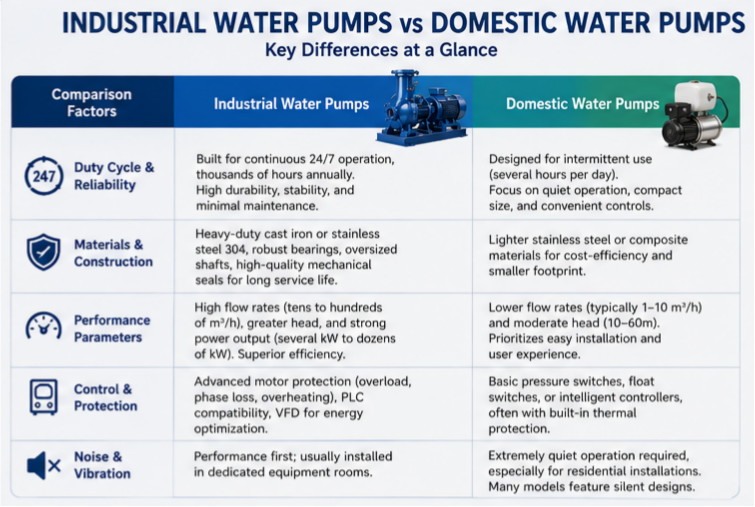
Duty Cycle & Reliability
Industrial Water Pumps: Built for continuous 24/7 operation, often running thousands of hours annually. Emphasis on durability, stability, and minimal maintenance.
Domestic Water Pumps: Designed primarily for intermittent use (several hours per day). Focus on quiet operation, compact size, and convenient automatic controls.
Materials & Construction
Industrial: Heavy-duty cast iron or stainless steel 304, robust bearings, oversized shafts, and high-quality mechanical seals for extended service life.
Domestic: Lighter stainless steel or composite materials to achieve better cost-efficiency and smaller footprint.
Performance Parameters
Industrial: Higher flow rates (tens to hundreds of m³/h), greater head, and stronger power output (several kW to dozens of kW). Superior hydraulic efficiency.
Domestic: Lower flow rates (typically 1–10 m³/h) and moderate head (10–60m). Prioritizes ease of installation and user experience.
Control & Protection
Industrial: Advanced motor protection (overload, phase loss, overheating), compatibility with PLC systems, and variable frequency drives (VFD) for energy optimization.
Domestic: Basic pressure switches, float switches, or intelligent controllers, often with built-in thermal protection.
Noise & Vibration
Industrial: Performance first; usually installed in dedicated equipment rooms.
Domestic: Extremely quiet operation required, especially for residential installations. Many models feature specialized silent designs.
2.Typical Applications
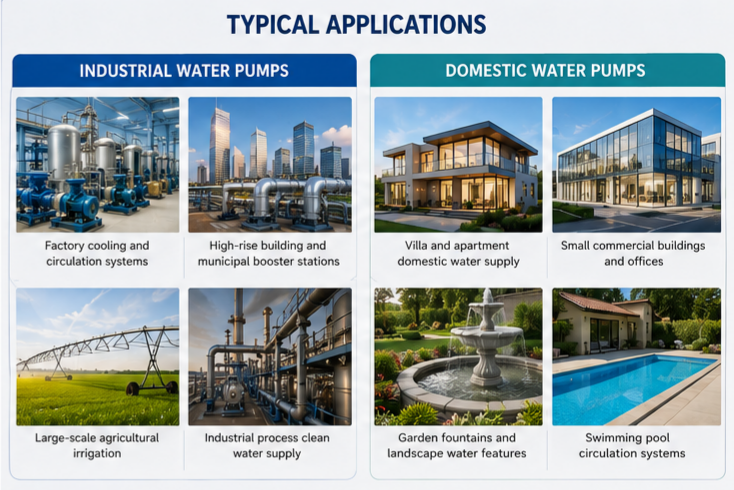
Industrial Water Pumps are commonly used in:
Factory cooling and circulation systems
High-rise building and municipal booster stations
Large-scale agricultural irrigation
Industrial process clean water supply
Domestic Water Pumps are ideal for:
Villa and apartment domestic water supply
Small commercial buildings and offices
Garden fountains and landscape water features
Swimming pool circulation systems
3.Buying Advice: How to Choose Correctly
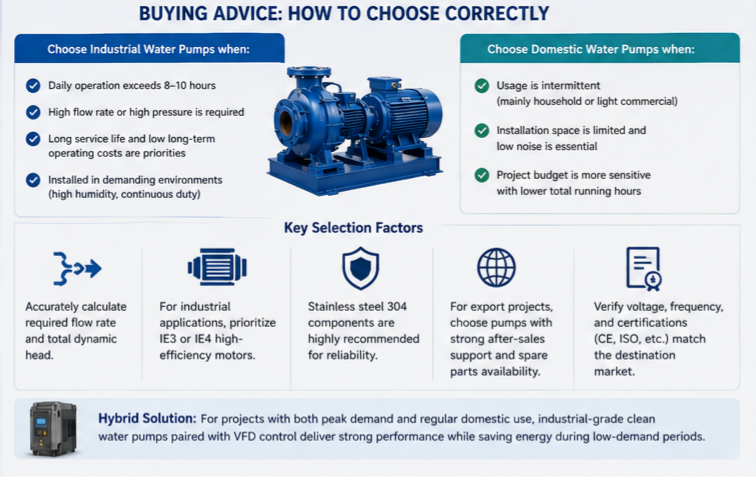
Choose Industrial Water Pumps when:
Daily operation exceeds 8–10 hours
High flow rate or high pressure is required
Long service life and low long-term operating costs are priorities
Installed in demanding environments (high humidity, continuous duty)
Choose Domestic Water Pumps when:
Usage is intermittent (mainly household or light commercial)
Installation space is limited and low noise is essential
Project budget is more sensitive with lower total running hours
Key Selection Factors
Accurately calculate required flow rate and total dynamic head.
For industrial applications, prioritize IE3 or IE4 high-efficiency motors.
Stainless steel 304 components are highly recommended for reliability.
For export projects, choose pumps with strong international after-sales support and spare parts availability.
Verify voltage, frequency, and certifications (CE, ISO, etc.) match the destination market.
Hybrid Solution For projects with both peak demand and regular domestic use, many clients select industrial-grade clean water pumps paired with VFD control. This delivers strong performance while saving energy during low-demand periods.
4.Common Buying Mistakes
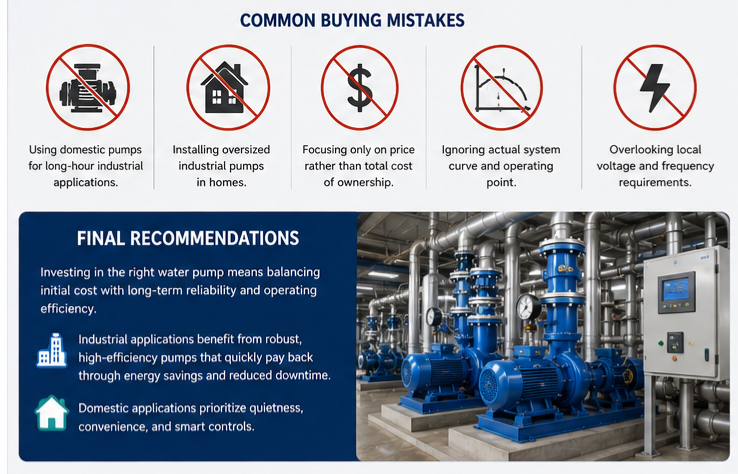
Using domestic pumps for long-hour industrial applications (frequent breakdowns).
Installing oversized industrial pumps in homes (noisy, high energy use).
Focusing only on price rather than total cost of ownership.
Ignoring actual system curve and operating point.
Overlooking local voltage and frequency requirements.
5.Final Recommendations
Investing in the right water pump means balancing initial cost with long-term reliability and operating efficiency. Industrial applications benefit from robust, high-efficiency pumps that quickly pay back through energy savings and reduced downtime. Domestic applications prioritize quietness, convenience, and smart controls.
Understanding these differences helps you select the most suitable clean water pump for your specific needs.