

Pumps are essential components in modern infrastructure, industrial systems, agriculture, and commercial operations. Their performance directly impacts system efficiency, energy consumption, and operational reliability. Understanding how pumps work, their types, and selection criteria is crucial for engineers, facility managers, and end users alike.
1.Basic Principles of Water Pumps
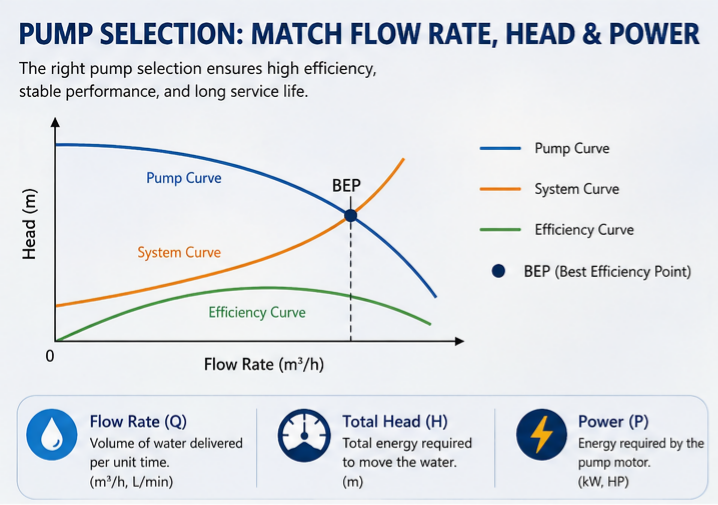
Water pumps convert mechanical energy into hydraulic energy to transport fluid from one location to another. Key performance parameters include:
Flow Rate (Q) — The volume of water delivered per unit of time, typically expressed in cubic meters per hour (m³/h) or liters per minute (L/min).
Total head (H) — The energy transferred to the water, measured in meters. It includes static head, friction losses, and the required discharge pressure.
Power (P) — The energy required by the pump motor, typically expressed in kilowatts (kW) or horsepower (HP). Proper power matching ensures efficiency and prevents premature wear.
Hydraulic efficiency and proper selection are critical for preventing energy waste and avoiding cavitation or excessive vibration.
2.Classification of Water Pumps
Water pumps can be broadly classified into the following categories:
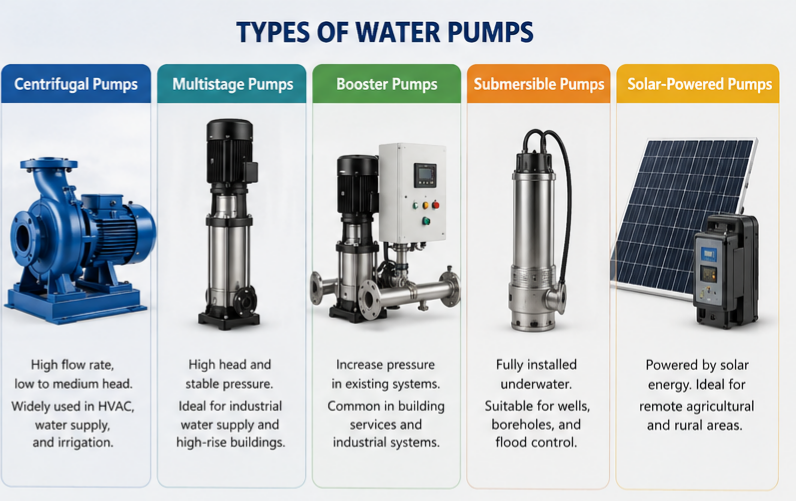
2.1 Centrifugal Pumps
These pumps transfer kinetic energy to water using a rotating impeller.
They are suitable for applications requiring high flow rates and low to medium head.
They are commonly used in HVAC systems, domestic water supply, and irrigation.
2.2 Multistage Pumps
Composed of multiple impellers connected in series to achieve high head.
Suitable for industrial water supply, high-rise buildings, and long-distance water conveyance.
Provides stable pressure and constant flow.
2.3 Booster Pumps
Used to increase pressure in existing systems.
Applied in building services, agricultural piping, and industrial recirculation systems.
Often used in conjunction with variable frequency drives (VFDs) to improve energy efficiency.
2.4 Submersible Pumps
Fully installed underwater.
Used for wells, boreholes, and flood management.
Features a space-saving design and operates quietly.
2.5 Solar-Powered Pumps
Powered by solar panels or photovoltaic systems.
Ideal for remote agricultural or rural applications without a reliable power supply.
Environmentally friendly and low-cost to operate.
3.Cross-Industry Applications
Water pumps have an extremely wide range of uses:
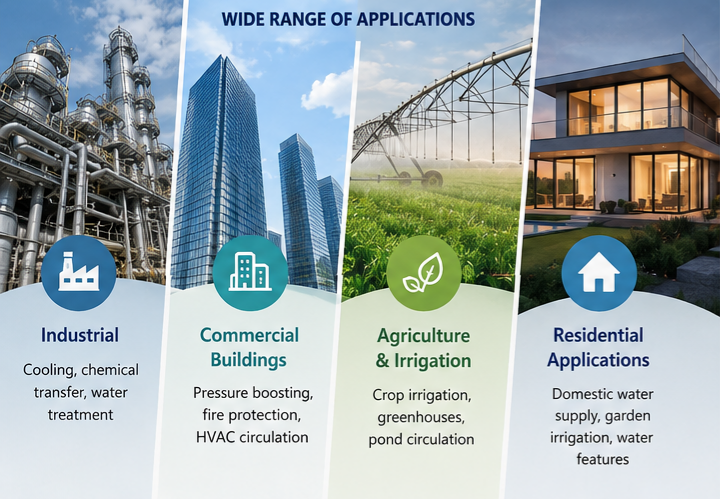
Industrial circulation systems—cooling water, chemical transfer, and water treatment.
Commercial buildings—pressure boosting, fire protection, and HVAC circulation.
Agriculture and irrigation—crop irrigation, greenhouse irrigation, and pond circulation.
Residential applications—domestic water supply, garden irrigation, and water features.
4.Key Considerations for Pump Selection
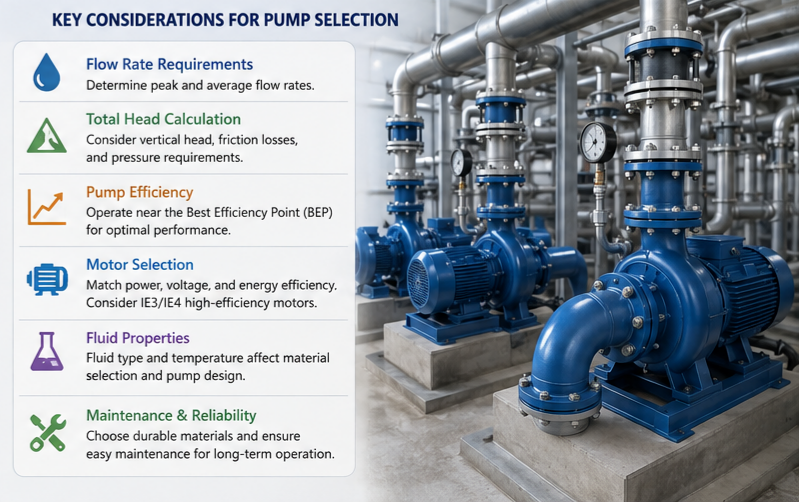
Flow Rate Requirements—Determine peak and average flow rates.
Total Head Calculation—Consider vertical head, friction losses, and pressure requirements.
Pump Efficiency—Select a pump that operates near the best efficiency point (BEP) on the pump performance curve.
Motor Selection—Ensure that power, voltage, and energy efficiency class are appropriate. For industrial-grade pumps, consider using IE3/IE4 high-efficiency motors.
Fluid Properties — Clear water, slightly turbid water, or chemical solutions can affect material selection and impeller clearance.
Operating Conditions — Continuous versus intermittent operation may influence pump type, materials, and control methods (variable frequency or fixed speed).
Maintenance and Reliability — Select corrosion- and wear-resistant materials. Stainless steel and corrosion-resistant alloys are typically preferred.
5.Avoid Common Mistakes
Selecting a pump based solely on motor power or pump body size.
Ignoring pipe length, diameter, and friction losses when calculating total head.
Operating the pump far from its performance curve, leading to cavitation and low efficiency.
Neglecting fluid temperature or chemical compatibility.
Ignoring installation factors such as suction conditions, alignment, and vibration damping.
6.Recommendations for Long-Term Operation
Ensure proper alignment and secure installation to minimize vibration and noise.
For systems with fluctuating demand, consider using parallel pumps or variable frequency drives.
Regularly inspect bearings, seals, and impellers to extend the pump’s service life.
Select materials that can withstand harsh environments (such as 304 stainless steel).
A properly selected pump operates quietly, maintains stable pressure, and requires minimal maintenance, providing years of reliable service.
Conclusion
From agriculture to high-rise buildings, pumps are critical assets in nearly every industry. Correctly matching flow rate, head, and power, while carefully considering application requirements, material selection, and maintenance, ensures energy-efficient, reliable, and durable equipment.
Draconis provides professional, high-quality pump solutions for industrial, commercial, and agricultural applications, combining durability, efficiency, and modern design.